Posted by Dr LEUNG Yuk Wah Natalie on 12 June 2010
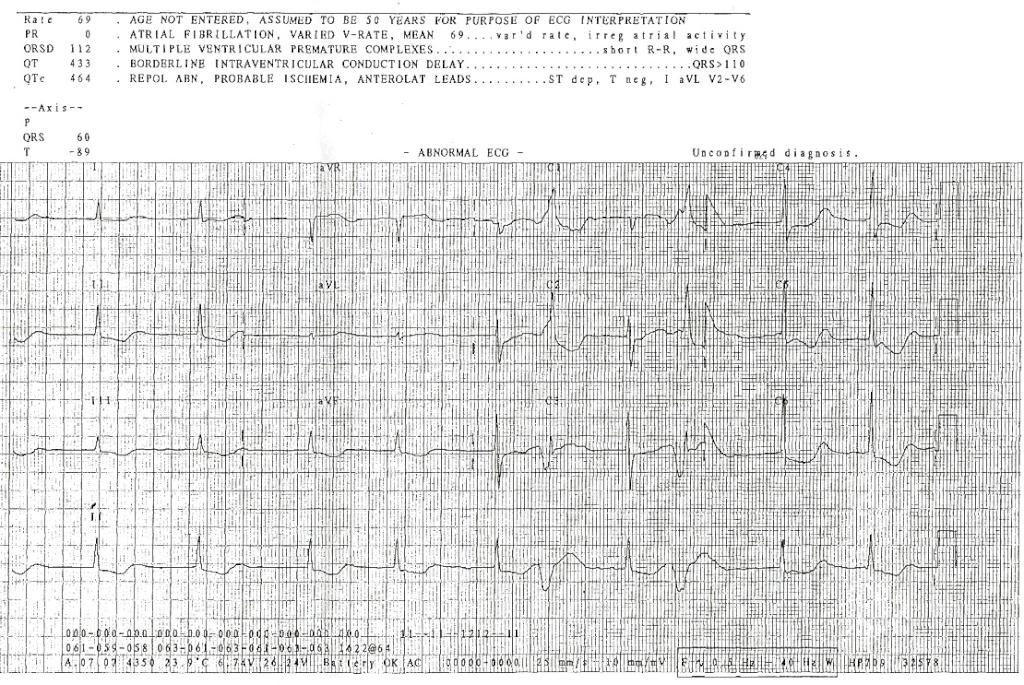
Figure. ECG on admission. Click image to enlarge
A 81-year-old lady had history of ischaemic heart disease, heart failure, hypertension and atrial fibrillation. She complained of shortness of breath, increased lower limbs edema for few days. She also had nausea and poor appetite. Her ECG is shown in Figure 1. The current medications were frusemide (lasix), aspirin, digoxin, losartan and simvasatatin (zocor). What are the abnormalities in the ECG? What may be the possible diagnosis?
Figure 1. Enlarged imaged of ECG on admission
Answers
Abnormalities in the ECG:
1. Atrial filbrillation
2. Ventricular ectopics
3. T wave inversion with ST depression
Diagnosis: Mild digoxin overdose, the digoxin level of this patient was 2.8 nmol/L (normal range 1-2.6 nmol/L)
Discussion
Although her dosage of digoxin was not changed recently, the dosage of lasix was increased due to heart failure, which could have caused the rise of digoxin level.
Digoxin is a cardiac glycoside extracted from Digitalis lanata. The electrical effects of digoxin on the myocardium are very complicated. It acts on the α-subunit of the Na/K ATPase pump in the membranes of heart cells (myocytes) and decreases heart rate, increases blood pressure and stroke volume. Overall, it improves myocardial efficiency and increases tissue perfusion. It is generally not recommended in patients with hypertrophic obstructive cardiomyopathy, Wolff-Parkinson-White syndrome, AV conduction block and diastolic dysfunction.

Figure 2. Digitalis lanta (Source: Wikipedia)
Common ECG changes in patients on digoxin with or without overdose:
1. Increased PR interval (decreased conduction velocity in AV node)
2. Decreased QT interval (because of altered duration of decreased action potential)
3. Inverted T wave with ST depression
4. AV junctional rhythm and ectopic beats, resulting in ventricular tachycardia and fibrillation
Its serum half-life is 1.5 days and it is mainly excreted by the kidneys. Adverse drug reactions are common due to its narrow therapeutic index. The adverse effects are concentration-dependent. They are more common in renal impairment, hypokalaemia (as digoxin competes with K ions for the same binding site on the Na/K ATPase pump), but hyperK will set in if there is overdose. Besides, the digoxin serum level may be higher in patients with lean body mass.
A numbers of drugs can affect digoxin plasma concentrations:
1. Quinidine, verapamil, amiodarone (by displacing tissue binding sites and depressing renal digoxin clearance)
2. ACEI, diuretic
Common symptoms of digoxin overdose are:
1. GI: anorexia, nausea, vomiting and diarrhoea
2. Neurological symptoms: dizziness, malaise, confusion, depression and coloured vision.
3. ECG abnormality: as above
Treatment of digoxin toxicity depends on the clinical severity. Supportive care is required. Correct hypo K and hypo Mg if present. For mild overdose cases, temporary withdrawal of digoxin is enough; anti-arrhythmic drugs like lignocaine and phenytoin can been used in specified arrhythmias. Atropine, temporary transvenous pacing may be required for patients with bradycardia or heart block. In severe cases, consider GI decontamination using gastric lavage, activated charcoal or multiple dose activated charcoal. It must be noted that cardioversion may precipitate refractory VT, VF, so start with low dose: 10-25J with pre-treatment with lignocaine or amiodarone. In life-threatening toxicity, where rapid reversal is needed, digoxin-specific antibodies are very effective. The indications for digoxin Immune Fab fragments indications are:
1. Brady or Vent arrhythmia not responsive to atropine
2. Serum K+ > 5mEq/dL in acute drug overdose
3. Digoxin level: 10-15ng/mL (13-19.5nmol/L) in an acute DO
4. Digoxin ingestion of > 10 mg
There has been a report (ref 4) of using hemofiltration to treat a patient with digoxin overdose complicated by refractory hyperkalemia, congestive heart failure, chronic renal failure, and complete atrioventricular heart block. Hemofiltration was associated with a progressive fall in plasma digoxin level and potassium level, accompanied by resolution of the heart failure and complete heart block. It was suggested that hemofiltration appeared to provide a therapeutic alternative in digoxin overdose. However, it was later commented that although only about 15% to 20% (0.15 to 0.25) of digoxin is protein bound, the major reservoir for the drug is skeletal muscle, while cardiac muscle contains about 30 times the amount present in serum. Therefore, the amount of drug that can be removed by hemofiltration is expected to be small.
For the progress of this patient, digoxin was stopped after admission. Figure 3 shows the ECG of the patient before discharge.

Fig 3. ECG in recovery stage at hospital discharge, click image to enlarge
References
1. Wikipedia:Digoxin
2. Hong Kong Medical Association Online Clinical Case Study (April 2010) http://www.hkma.org/english/cme/clinicalcase/201004a_set.htm
3. Handbook of Internal Medicine 5th Edition
4. Kar Neng Lai, MD, MRCP; Ramasamyiyer Swaminathan, MBBS, PhD, MRCPath; Chiu On Pun, MBBS, MRCP; John Vallance-Owen, MD, FRCP, FRCPI, FRCPath. Hemofiltration in Digoxin Overdose. Arch Intern Med. 1986;146(6):1219-1220.