
A 40-year old lady who had bicuspid aortic valve and history of R ovarian cystectomy with OT done >10 years ago was admitted for fever. Blood culture grew Aggregatibacter actinomycetemcomitans.
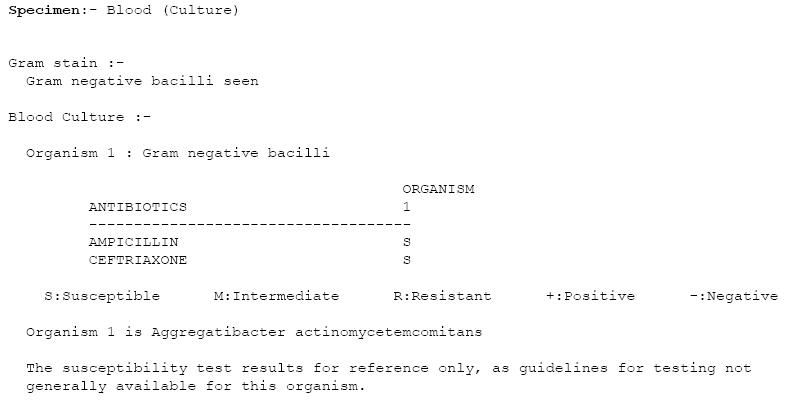
Figure. Blood culture result, click image to enlarge.
Which of the following is not correct?
A. The patient likely had subacute bacterial endocarditis.
B. In the present case, the bacteria is very likely a contamination.
C. The bacteria is part of the HACEK group of bacteria.
D. The bacteria is only sensitive to ceftriaxone (rocephin) in vitro.
E. If inadequately treated, it could lead to mycotic cerebral aneurysms
Answer: B
Discussion
The HACEK group of organisms are slow-growing Gram negative bacteria that form a normal part of the human oropharyngeal flora. It is a frequent cause of culture-negative endocarditis because they are fastidious, which means it requires specific nutrient for culture, and therefore it is only done if the microbiology lab is aware of the suspicion of infective endocarditis.
The HACEK group includes:
1. Haemophilus (Haemophilus influenzae)
2. Aggregatibacter (formerly: Actinobacillus) – Aggregatibacter actinomycetemcomitans, Aggregatibacter aphrophilus
3. Cardiobacterium hominis
4. Eikenella corrodens
5. Kingella (Kingella kingae)
Aggregatibacter actinomycetemcomitans is an oral commensal found also in severe infections in the oral cavity, mainly the periodontium.
The normal aortic valve has 3 equal-sized leaflets or cusps with 3 lines of coaptation. A congenitally bicuspid aortic valve has 2 functional leaflets.The important clinical consequences of bicuspic aortic valvular disease are valvular stenosis, regurgitation, infective endocarditis, and aortic complications such as dilation and dissection
TEE of this patient showed normal LV systolic and diastolic functions, moderate to severe AR, and an echodense leison over ventricular surface of AV, and mild MR. She was treated with a four-week course of ceftriaxone (Rocephin). However, follow-up echocardiogram still showed showed persistent AV vegetation, moderate to severe AR, and as exercise tolerance dropped to one flight of stairs only, she was assessed for valvular replacement. Unfortunately, during the period of assessment, she presented to the ICU for loss of consciousness due to mutiple cerebral mycotic aneurysm and bleeding.
Reference
1. Paul W.M. Fedak, MD; Subodh Verma, MD, PhD; Tirone E. David, MD; Richard L. Leask, PhD; Richard D. Weisel, MD; Jagdish Butany, MD. Clinician Update: Clinical and Pathophysiological Implications of a Bicuspid Aortic Valve. Circulation. 2002;106:900. (Link here)
2. L. Paturel1, J. P. Casalta1, G. Habib2, M. Nezri3 and D. Raoult1. Review: Actinobacillus actinomycetemcomitans endocarditis. Clin Microbiol Infect 2004; 10: 98–118 (Link here)