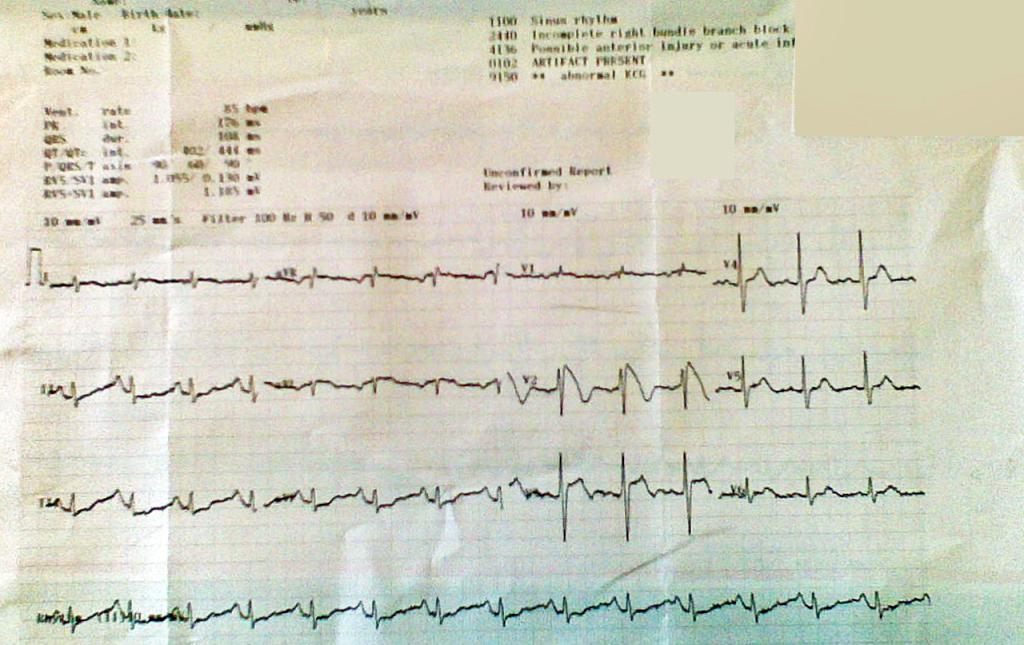
The following ECG was obtained from a 74-year-old man before emergeny operation for acute abdomen. Both TnT and echocardiogram were normal. Which of the following was incorrect about this condition?
A. It is a genetic disease that is characterised by abnormal ECG findings and an increased risk of sudden cardiac death.
B. In 20% of patients, it affects the alpha subunit of the Na+ channel by alteration of chromosome 3 and mutation in the SCN5A gene. Other genetic defects that affect calcium channels can also be involved.
C. The right ventricle is most affected in Brugada syndrome, and particularly (but not specifically) the right ventricular outflow tract .
D. This condition is inherited in an autosomal recessive pattern and is more common in females. It has a higher prevalence in most Caucasian populations.
Answer: D
The ECG is typical of type 1 Brugada syndrome. This condition is inherited in an autosomal dominant pattern and is more common in males. It has a higher prevalence in most Asian populations.
The ECG in Brugada syndrome has 3 different types of patterns:
| Leads V1 – V3 | Type 1 | Type 2 | Type 3 |
|---|---|---|---|
| ST-T pattern | Coved | Saddleback | Saddleback |
| Terminal ST-segment | Gradual down slope | Elevated >= 1 mm | Elevated >= 1 mm |
| J point* | >= 2 mm | >= 2 mm | >= 2 mm |
| T wave | Negative | Positive or biphasic | Positive |
*J point is the junction point between the end of QRS complex and beginning of the ST-segment. P-Q segment is the baseline reference for J point elevation consideration.
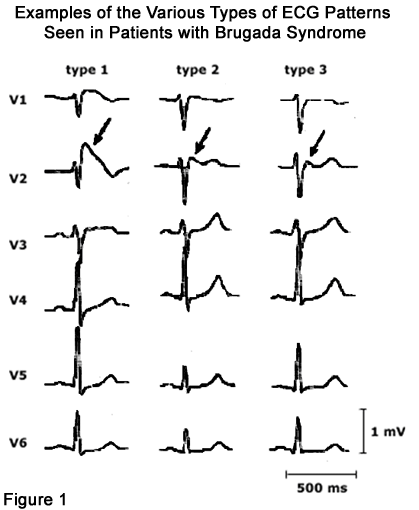
Our patient shows the type 1 pattern. The ECG can fluctuate over time, depending on the autonomic balance and the administration of antiarrhythmic drugs.

Dr Pedro Brugada
Reference
1. Mok NS. Brugada Syndrome: A newly recognized sudden death syndrome in Hong Kong. v 6, n 6, 2001 (free fulltext here)
2. Oruganti Sai Satish, MD, DM; Kuan-Hung Yeh , MD; Ming-Shien Wen , MD. Brugada Syndrome-An Update. Chang Gung Med J Vol. 28 No. 2
February 2005 (free fulltext here)