
Which of the following is not Karl R. Popper‘s approach to the philosophy of science?
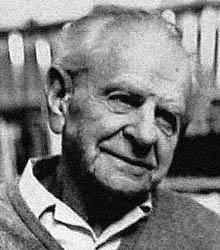
Figure. Karl R. Popper (1902 – 1994)
A. It is wrong to begin by accumulating observations to seek confirmation of a theory, i.e. the so-called induction method.
B. Repeated observations and experiences should function in science as tests of our conjectures or hypotheses, i.e. attempted falsifications.
C. We should advance bold conjectures derived from intuition, or creative genius, or anyway we like, and attempt to refute them.
D. Development of empiricism was greatly enhanced by Karl Popper’s philosophy.
Answer: D
In the philosophy of science, empiricism emphasizes those aspects of scientific knowledge that are closely related to evidence, especially as discovered in experiments. It is a fundamental part of the scientific method that all hypotheses and theories must be tested against observations of the natural world, rather than resting solely on a priori reasoning, intuition, or revelation. Development of empiricism was greatly influenced by the empirical method of science that emphasized induction through observation and experimentation, as believed by Francis Bacon (1561 – 1626). The method of induction was criticized by Popper because he considered that it is easy to obtain confirmation, or verification, for nearly every theory. He believed that the criterion of the scientific status of a theory should instead be its falsifiability, or refutability, or testability. That means, the approach should be that a true theory should stand our repeated observation and experimentation to prove it to be wrong, not to prove it to be right. It it can be proved wrong, i.e. falsified, alternative theory should be sought.