Submitted on 11 June 2009
A 46 year-old man came back from Fujian province of China two days ago. He
developed fever, malaise, sorethroat and dry cough for one day. Temperature was 38 Celsius degrees at AED, and
physical examination was grossly unremarkable except bilateral tender cervical lymphadenopathy. CXR was reported as
NAD. Because of the travel history and URI symptoms, he was admitted into an isolation room of the medical
department for suspected influenza.
At the evening of admission, rapid test of NPA for
viral influenza antigens was
negative. He started to complain of shortness of breath with chills and rigors. SaO2 became 80% on room air and
then 100% with 50% O2 mask. A neck x-ray and repeated CXR were ordered. ICU was consulted for considering
endotracheal intubation and ventilatory support for suspected severe pneumonia.
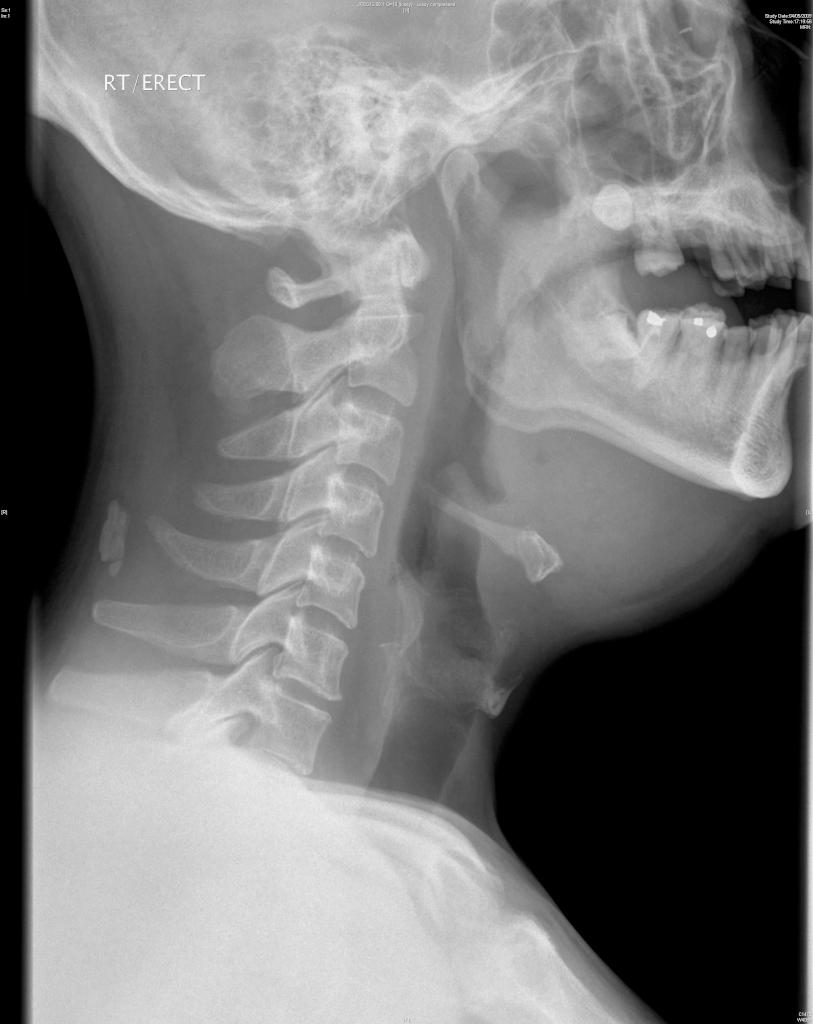
With the help of the x-ray as shown, what will be
your preferred intubation strategy?
Click readmore for answer and more images.
The lateral neck x-ray shows severe soft tissue
swelling at the submandibular region. The mass effect is evidenced by displacement of epiglottis
downwardly and backwardly, and the obliteration of oral cavity by an upwardly displaced tongue. The
epiglottics itself is very minimally swollen, and the space at the valleculae appears preserved. There is
gas in the subfascial tissue at the submandibular region as well.
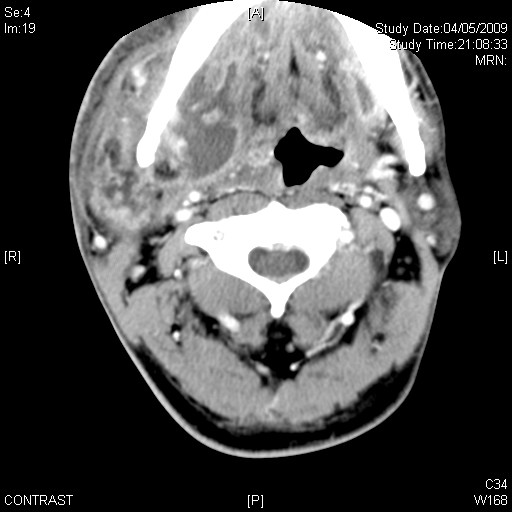
He was suspected to suffer from submandibular
abscess with gas formation, leading to upper airway obstruction. Being closely monitored at ICU, an urgent
contrast CT neck was performed before endotracheal intubation. Selected images are shown
below.
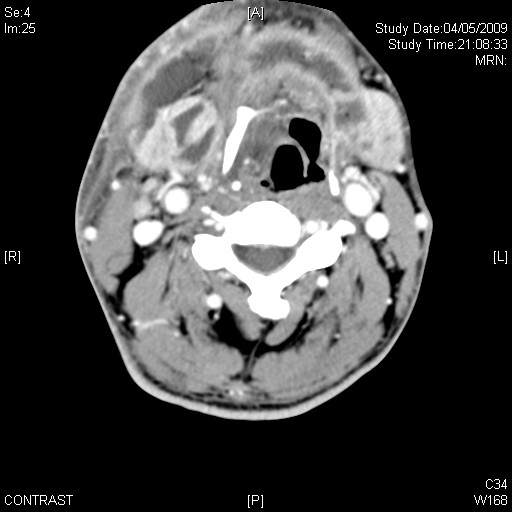
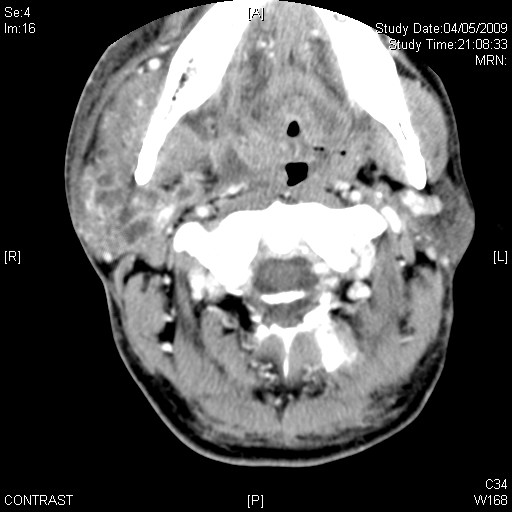
Awake fibre-optic guided nasal intubation was performed at operation theatre.
Urgent tracheostomy and debridement + drainge of abscess was then performed in the next
morning.