Submitted by Dr Arthur CW Lau, Pamela Youde Nethersole Eastern Hospital, Date: 23 May 2010
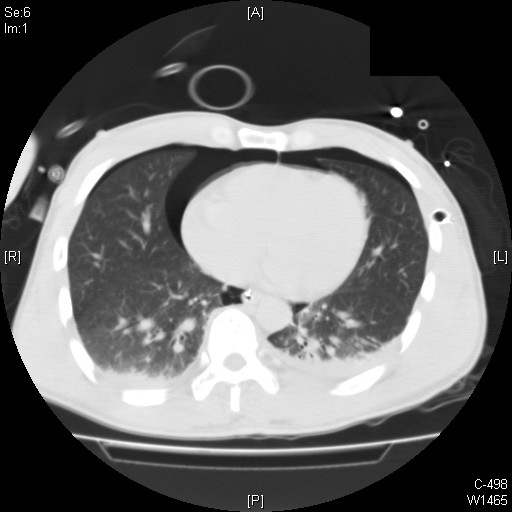
Figure. CT thorax of the patient. Click Read More to see more photos.
A 40-year man worked under water of around 20m depth for some business. He claimed to have seen a ghost there and was therefore scared and ascended quickly back up to sea level. He then lost consciousness for 1 to 2 minutes and complained of multiple joint pain and chest pain. On arrival to AED, his GCS was 15/15. Why did he see a ghost there? What has happened to him afterwards? Whole body CTs were performed. Click Read More.
CT brain
It shows some suspicious hypodensity is noted in the high left frontal-occipital lobe, which may represent a recent infarct or artefact.
CT thorax
{morfeo 78}
Gas density is seen around the oesophagus and descending aorta, which can represent pneumomediastinum. Pneumothorax is seen in the scanned portion of bilaterlal lung bases. A 8mm oval shaped gas density is seen in the right posterior lung base, which can be a subpleural cyst or another small pneumothorax. Collapse-consolidation is noted over bilateral posterior lung bases, being more marked on the left side.
CT Abd and Pelvis
{morfeo 79}
A small patch of pneumoperitoneum is seen anterior to the left lobe of the liver and in the falciform ligament. A small pocket of gas is seen over posterior aspect of the left lobe of the liver (? intraparenchymal). A gas density is noted between the aorta and the spleen (with ? posterior relation to the pancreas). Small pockets of gas in close association with the bowel loop would be difficult to differentiate their origin as intra- or extra-luminal in non-contrast scan.
Progress
Chest drain was inserted. Contrast swallow showed no leakage of esophagus and stomach. He had rhadomyolysis (CK >20000), urine was reddish, forced alkaline diuresis was started. He later developed right UL weakness after admission. He was then transferred for recompression treatment. The Royal Navy Table 62 was used. A second recompression treatment was done for ~6 hours the next day, but still no improvement in limb power noted. He then underwent the 3rd recompression session on the third day, and later right upper limb power improved to 3/5.
Clinical Diagnosis
Nitrogen narcosis in deep sea, and decompression illness (DCI) because of rapid ascent
Discussion
The "ghost" seen by our patient was probably a hallucination due to nitrogen narcosis, but unfortunately this led to his rapid ascent and the subsequent decompression illness.
In a depth of 10–30 m under water, the pressure is 2 to 4 bar. This increase in pressure (Henry’s Law) causes increased solubility of gases in body tissues. It was suggested that inert gases dissolving in the lipid bilayer of cell membranes cause narcosis. Significant symptoms and signs of narcosis is increasing likely at depths of about 30 m (100 ft), corresponding to an ambient pressure of about 4 bar (400 kPa). Most sport scuba training organizations recommend depths of no more than 40 m. In a depth of 10 to 30 m, divers may develop mild impairment of performance of unpracticed tasks, mildly impaired reasoning and mild euphoria. Deeper diving will lead to hallucinations, loss of memory, and unconsciousness.
Rapid transfer to a recompression centre for treatment is the cornerstone of successful management of life-threatening DCI. Hyperbaric oxygen (HBO) therapy is the breathing of 100% oxygen inside a treatment chamber at a pressure higher than one atmosphere absolute (1 ATA). The Recompression Treatment Centre in Hong Kong is in Ngong Shuen Chau (Stonecutters Island). Unfortunately, it is not attached to any acute hospitals, and there are only basic monitoring and resuscitative equipments and the environment is not spacious. It is hoped that in future an in-hospital HBO treatment centre of adequate space can be set up in Hong Kong with trained medical, nursing and technical staff to provide hyperbaric therapy and consultation.
A Position Statement of the Hong Kong Society of Critical Care Medicine on The Protocol of Hyperbaric Oxygen Therapy for Critically Ill Patients in Hong Kong was prepared by Dr YAN Wing Wa, Chairman of the Hong Kong Society of Critical Care Medicine (HKSCCM), on behalf of the HKSCCM. It was endorsed by the HKSCCM Council in the 14th Council Meeting on 18th May 2010, and has been posted on our website here.