Answer: E
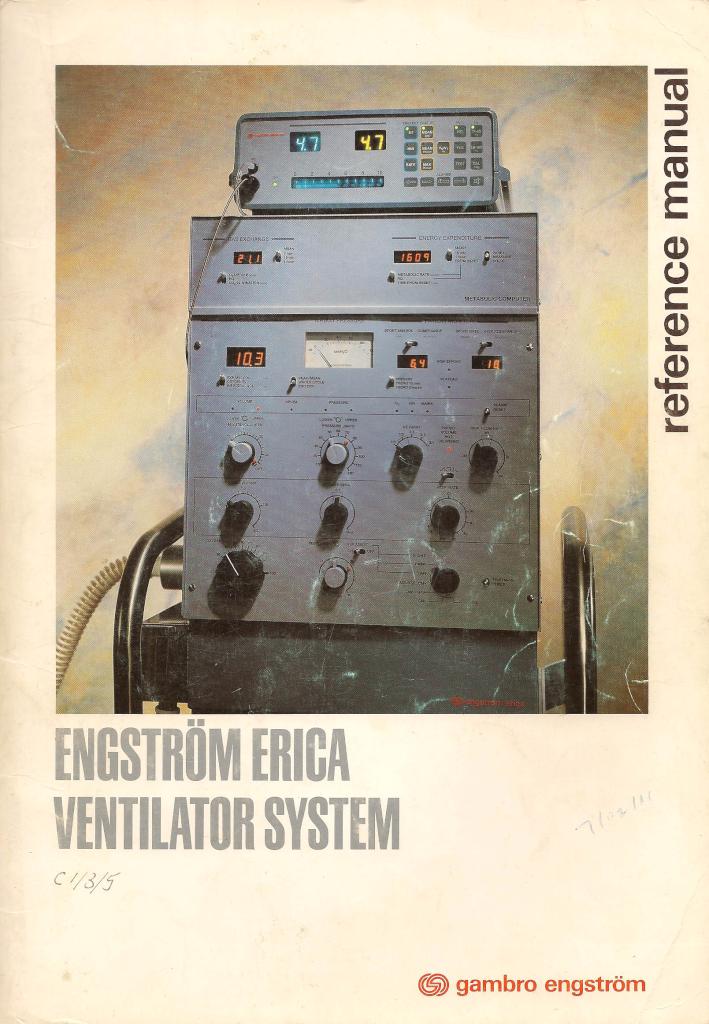
Figure. The Engstrom Erica Ventilator System Reference Manual (Courtesy of Dr WW Yan)
A. This is a system for both mechanical ventilation and indirect calorimetry. Direct calorimetry postulates among other things that the patient must be placed in an airtight box in order to measure the heat emission, which is clearly not practical in the clinical setting. Indirect calorimety estimates total energy expenditure from O2 consumption and CO2 production, therefore it is indirect. The equation used in this system is Energy Expenditure, EE = 1.32 VO2 (1.23RQ + 3.81) kcal/24 h (with several assumptions).
B. Indirect calorimetry measures the total metabolic cost of the whole body, but the Campbell method measures only mechanical work of the respiratory system. Moreover, the Campbell method cannot meaure isometric work (no change in muscle length), in which no displacement takes place, and therefore no mechanical work is performed, though there is an associated metabolic cost.
C. REE is not exactly equivalent to BMR. REE is actually BMR + Specific Dynamic Action of Food (SDAF, or thermogenic response). SDAF is the increase in energy expenditure evoked by nutrition itself. REE + Activity Energy Expenditure (AEE) is the Total Energy Expenditure (TEE)
D. RQ should refer to the ratio of CO2 production and O2 consumption at the cellular level. RER (VCO2/VO2) is the measured values by indirect calorimetry from inspired and expired gases. RER is only equivalent to RQ at steady state, and by definition, steady-state means that the pulmonary CO2 elimination is equal to the total body CO2 production and that O2 uptake equals O2 consumption.
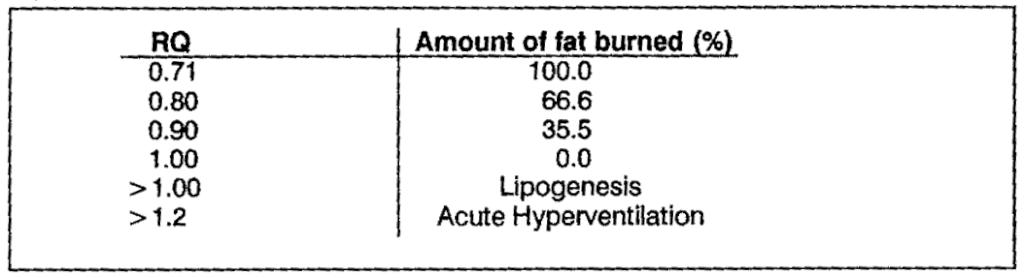
E. An RQ (or RER at steady-state) may reflect the relative oxidation of fat and carbohydrates. Although RER also reflects the oxygen consumption and carbon dioxide production yielded from protein metabolism, the error generated by neglecting this is <2%. A mixed diet of fat and carbohydrate results in an average value between 0.71 and 1.0. Overfeeding may increase the RQ above 1 due to net lipogenesis, and hyperventilation can lead to RQ >1.2. Both under-feeding and over-feeding, for various reasons, may impede weaning. The use of indirect calorimetry enables more accurate measurements of RQ and total energy expenditure than just using the Harris Benedict formula.