Regarding Stewart’s approach to acid-base, which of the following is
incorrect?
A. In the control of pH, there are 3 independent variables (pCO2, SID and [ATot]) and 6 dependent
variables ( [HA], [A-], [HCO3-], [CO2-3], [OH-], [H+] )
B. Low SID is associated with acidosis
C. Hypoalbuminemia is associated with alkalosis
D. Infusion of lactated Ringer’s solution produces more acidosis than normal saline solution because of the presence
of lactate.
Answer: D
Refer to the following diagram for the terminology for discussion, because sometimes different authors may use
the same terminology to refer to different things.
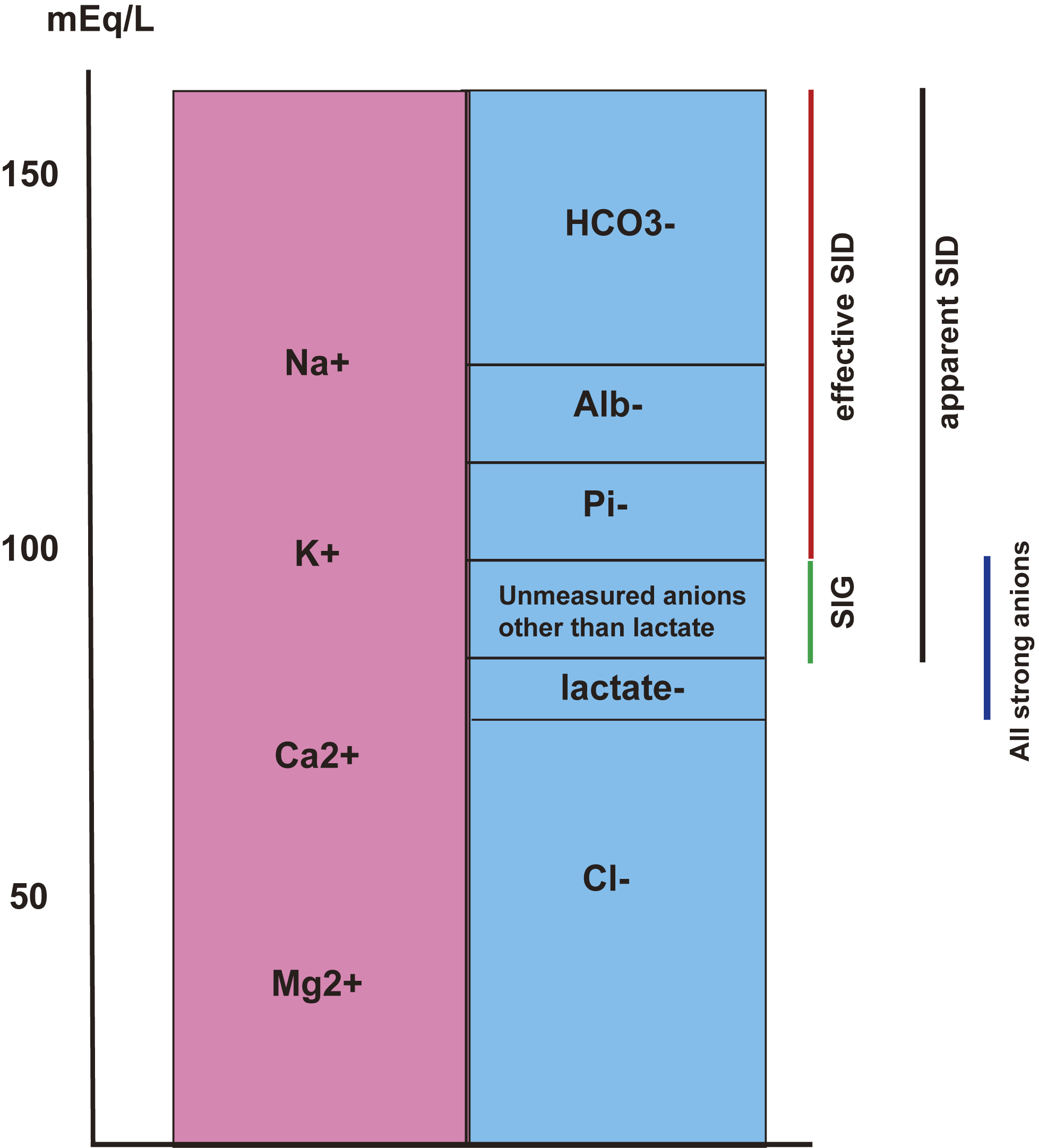
Figure. Composition of strong ions in plasma for the understanding of the Stewart’s
approach. Note that for actual calculation it has to be done in terms of mEq/L instead of mmol/L, and since albumin
and phosphate are not fully dissociated, [alb-] and [Pi-] have to be worked out by equations taking into
account the pH. See later discussion. SID = strong ion difference; SIG = strong ion gap; Size of bars are not
to scale to their actual concentration, it is for conceptual understanding only. For the discussion of fluid
instead of plasma, effective SID has to be understood as all strong cations (red bar) minus chloride and minus
lactate-. Lactate and other unmeasured anions are to be estimated in the clinical application on
plasma (cations – Cl- – HCO3- – Alb- – Pi-), but is known in most IV fluid which has no HCO3-, Alb- and
Pi-, thus creating certain confusion in the understanding of this approach.
Intravenous administration of a crystalloid solution changes two of the three independent determinants of pH in
Stewart’s approach. The fluid may alter the SID (depending on the type of fluid administered), and lower
Atot (thus increase pH), where Atot = the total concentration of non-volative weak acid in the solution, the
major ones are Alb- (majority) and Pi- (minority). As a result, the net effect on pH depends on volume infused and the
SID of the solution. The effect is shown in the following figure (reference: Anesth Analg 2004).
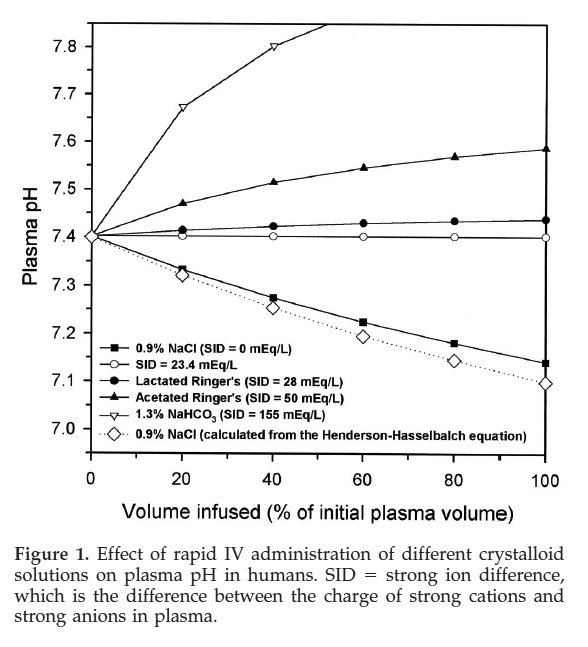

The theoretical maximum effective SID is the final SID after complete metabolism of metabolizable strong anions,
i.e. lactate in lactated Ringer’s solution, acetate gluconate in acetated Ringer’s solution). Crystalloid
solutions that have an effective SID < 23.4 mEq/L will decrease pH, and those with effective SID >
23.4 mEq/L will increase pH. Lactated Ringer’s solution is a racemix mixture of L- and D-lactate. Lactate is to be
metabolised, thus maintaining a certain SID, but because D-lactate is unlikely totally metabolized, although its
theoretical maximum SID is 28 mEq/L, the effective SID is just around 23.4, and therefore it has minimum effect on
pH. Normal saline has a SID of zero, and during rapid infusion, Cl- is not immediately metabolized, so NS is
acidifying due to its low SID.
The Henderson-Hasselbalch approach, the Siggaard-Anderson approach and the Stewart’s approah actually
describe the same phenomenon from different perspectives, and it seems that the Stewart’s approach is the
most comprehensive of all approaches, taking into account both the physical and chemical (i.e. a
physiochemical approach) properties of a fluid, and as a result it may be more difficult to understand.
Reference
Letter to the Editor: Richard M. Effros, MD. Stewart Approach Is Not Always a Practical Clinical ToolAnesth
Analg 2004;98:271-272; and the Response: Peter D. Constable, BVSc, PhD. Anesth Analg 2004;98:271-272