
Submitted by Dr LAU Chun Wing Arthur, ICU, PYNEH, Hong Kong, on 23 May 2009
About the monitoring of heparin dose, which of the following is incorrect?
A. The methods include whole blood clotting time (WBCT), heparin level assay, activated partial thromboplastin time (aPTT), and activated clotting time (ACT).
B. The correlation between aPTT and ACT is high.
C. ACT is frequently used for situations which require high dose of heparin (e.g. cardiopulmonary bypass, during PTCA), because of the linear relationship between heparin concentration and the ACT.
D. The aPTT has a lack of correlation with high heparin plasma concentration.
Answer: B
The correlation between aPTT and ACT is low. The correlation coefficient is in the range of around 0.6 only.
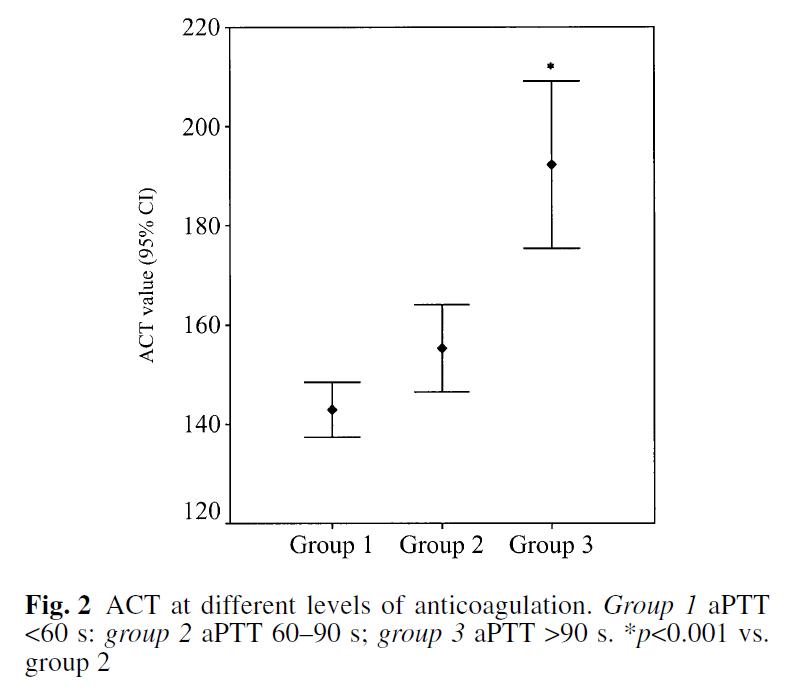
At low range of aPTT, ACT does not change much, but it increases a lot at above 90s. In the following reference, it was concluded that ACT could not distinguish between inadequate and adequate levels of anticoagulation.
Reference
Jan J. Waele, Sebastiaan Cauwenberghe, Eric Hoste, et al. The use of the activated clotting time for monitoring heparin therapy in critically ill patients. Intensive Care Med (2003) 29:325–328.