
Submitted by Dr LAU Chun Wing Arthur, ICU, PYNEH, Hong Kong, on 29 May 2009
The Fick principle states that the amount of oxygen extracted from the respired gases = the amount of oxygen added to the blood which flows through the lungs. In form of an equation:

where VO2 is the oxygen consumption rate, Q the cardiac output, and CaO2 – CvO2 is the arterial-mixed venous oxygen content difference.
Because the Fick principle was originally meant for calculation of cardiac output, it is re-arranged as:
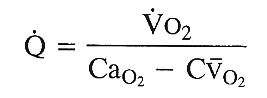 (The Fick equation)
If VO2 is meant to be calculated with knowledge of cardiac output by other means, we use the following by rearrangement:
(The reverse Fick equation)
Looking at this reverse Fick equation, from the units on both sides of the equation, it can be understood that:
L of oxygen consumed/min = L of blood/min x (L of oxygen consumed/L of blood)
Which of the following is not correct about the use of the above equations?
A. To calculate VO2 in the ICU using the reverse Fick equation, it is most accurate in the situation when the lung are inflamed and consuming a lot of oxygen.
B. Whether the Fick or reverse Fick equations is used, a pulmonary artery catheter is needed to get the necessary values for calculation.
C. When the Fick equation is used to estimate cardiac output, VO2 is measured by a metabolic cart (indirect calorimetry), and this VO2 is the whole body oxygen consumption rate.
D. When the reverse Fick equation is used to estimate VO2, cardiac output can be obtained by the thermodiluation technique with the pulmonary artery catheter.
Answer: A
Look at the following diagram:
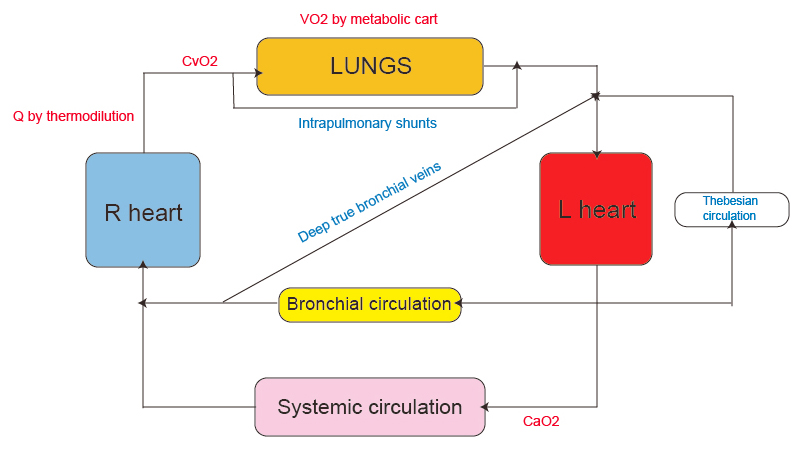
The Fick equation was developed by Adolf Eugen Fick (1 April 1828, in Kassel, Germany – 21 August 1901, in Blankenberge, Flanders), a German physiologist, who was usually credited with the invention of contact lenses.
When the reverse Fick equation is used to calculate VO2 using the Q measured by thermodilution, oxygen consumption of the lungs is excluded because the CaO2 – CvO2 difference does not include the lungs. So the VO2 thus measured has substantial systematic error if the lungs are inflamed, as in many ICU patients, making the measurement of VO2 invalid. To measure the VO2 of the whole body, it has to be measured from the lungs by the metabolic cart (indirect calorimetry). If there is significant lung tissue oxygen consumption, the VO2 measured by the metabolic cart will be higher than that measured by the reverse Fick equation. See this example.
When the original Fick equation is used to calculate cardiac output using the VO2 measured by the metabolic cart, again, the CaO2 – CvO2 difference does ot include the lungs, and there will be error if there is appreciable pulmonary oxygen consumption as in inflamed condition. Moreover, although the calculation includes intrapulmonary shunt (e.g. flow through atelectatic lungs), if there is appreciable extrapulmonary shunts (e.g deep true bronchial veins and the Thebesian circulation of the left heart) causing significant extrapulmonary admixture of venous blood, the situation is complicated and is beyond the possibility of easy solution.
Another utilzation of the Fick principle is seen in non-invasive exercise lung function test. The term oxygen pulse is VO2/HR, and is derived as follows:
– VO2 = Q x (CaO2 – CvO2)
– VO2 = HR x SV x (CaO2 – CvO2), where SV is stroke volume
– VO2/HR = SV x (CaO2 – CvO2)
The oxygen pulse rises with exercise. It’s immediate increase is due to increase in SV, while the latter increase is explained by increasing CaO2-CVO2 difference from tissue oxygen extraction.
The pulmonary artery catheter has to be used to get the Q and mixed venous blood for the reverse Fick equation, or just the mixed venous blood for the original Fick equation.
References
1. Andrew B. Lumb MB BS FRCA (Author). Nunn’s Applied Respiratory Physiology
2. Karlman Wasserman, James E Hansen, Darryl Y Sue, William W Stringer, Brian J Whipp. Principles of Exercise Testing and Interpretation: Including Pathophysiology and Clinical Applications
3. Peyton, P. J.; Robinson, G. J. B. Measured pulmonary oxygen consumption: difference between systemic oxygen uptake measured by the reverse Fick method and indirect calorimetry in cardiac surgery. Anaesthesia. 60(2):146-150, February 2005.