
Submitted by Dr LAU Chun Wing Arthur on 26 April 2009
Department of Intensive Care, Pamela Youde Nethersole Eastern Hospital, Hong Kong
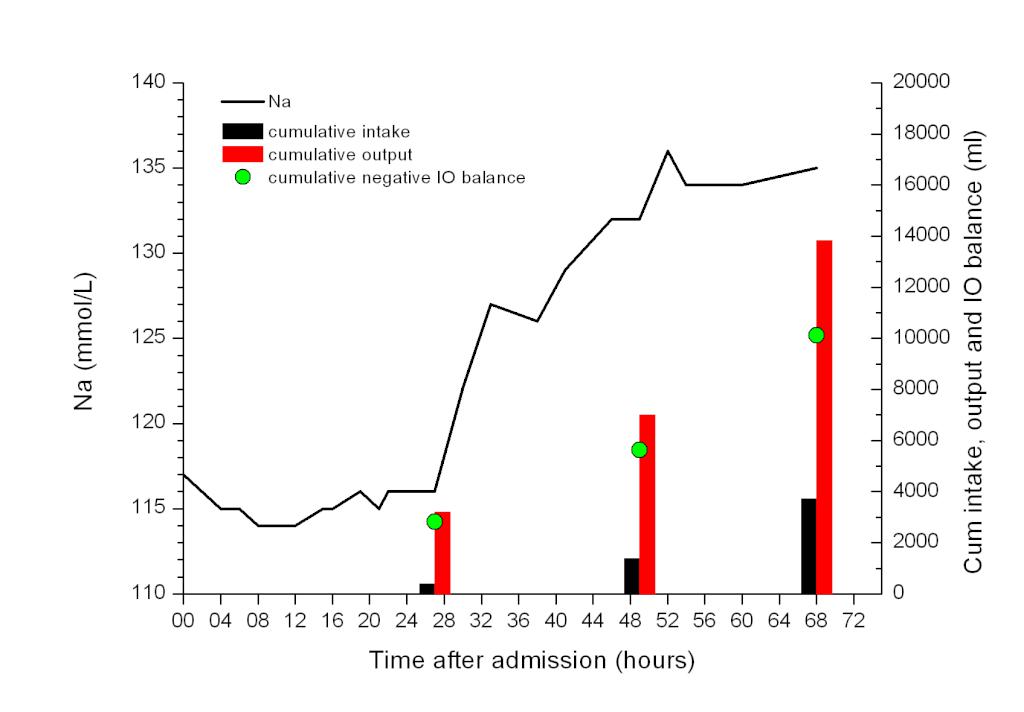
Figure 1. Trends of serum Na, cumulative intake, output and IO balance after hospital admission.
A 35-year-old man was admitted to the ICU because of generalised tonic-clonic convulsion. Before the seizure, he developed drowsiness after hiking for 9 hours and claimed to have taken in more than 4 litres of fluid. Sodium level was 117 mmol/L. CXR showed pulmonary edema, and echocardiogram revealed normal cardiac function. CT brain showed mild cerebral edema. Serum osmolality was 237 mosm/kg, urine osmolality 711 mosm/kg. Thyroid function tests were normal, morning cortisol 690 nmol/L. Urine was turbid. Highest serum CPK was 17922 IU/L. He required mechanical ventilation because of low GCS and respiratory failure.
Click Read More.

Figure 2. Marathon-associated water intoxication. Source: Oriental Daily News, 20 April 2009. (The patient under discussion is not the same one being reported.)
Diagnosis
Severe hyponatremia associated with hiking, complicated with cerebral edema, non-cardiogenic pulmonary edema
Rhadomyolysis post-prolonged exercise
Discussion
Our patient’s sodium level normalised only after a cumulative negative I/O balance of 10126 ml over 68 hours. He recovered without sequelae.
The primary cause of marathon-associated hyponatremia is water intake in excess of sodium loss. Exercise causes reduction in renal blood flow and glomerular filtration, and so the normal physiologic responses to water intoxication may be easily overwhelmed. In a study of participants in the 2002 Boston Marathon, of the 488 runners (64 percent) who provided a usable blood sample at the finish line, 13% had hyponatremia (a serum sodium concentration of 135 mmol per liter or less); 0.6 percent had critical hyponatremia (120 mmol per liter or less). On multivariate analysis, hyponatremia was associated with weight gain (odds ratio, 4.2; 95 percent confidence interval, 2.2 to 8.2), a racing time of >4:00 hours (odds ratio for the comparison with a time of <3:30 hours, 7.4; 95 percent confidence interval, 2.9 to 23.1), and body-mass-index extremes.
Urine output in many hours after admission was not high, and we were only able to get the sodium level to an upward trend after >24 hours. Our patient’s hyponatremia developed rapidly, so the sodium level could have been made to rise more rapidly, e.g with hypertonic saline, without the fear of complications like central pontine myelinolysis. The safety of hypertonic saline for the treatment of hyponatremic encephalopathy has been marginalized in the literature (Sterns RH 1994). Noncardiogenic pulmonary edema due to increased intracranial pressure from cerebral edema as a presenting feature of hyponatremic encephalopathy in marathon runners as in our patient has been reported before (Ayus 2000). It has been suggested that runners with hyponatremia be treated with 100 ml of 3 percent sodium chloride solution for 10 minutes to raise the serum sodium concentration rapidly by 2 to 3 meq per liter to decrease brain edema. The turbid urine could be due to rhadomyolysis, as well as the so-called "athletic pseudonephritis", in which urinary casts and proteinuria are commonly found in marathon runners.
The serum and urine osmolality profile is not exactly the same as that for pure excessive water intake in which ADH activity is suppressed so that a dilute urine can be excreted. In our patient, the urine osmolality is inappropriately high in face of a low serum osmolality and more-than-adequate hydration. In fact, the pathophysiology of marathon-associatd hyponatremia may include a component of antidiuresis (NEJM correspondence, Volume 353:427-428 July 28, 2005 Number 4). Because of this mechanism, the condition may be less amenable to correction with sodium, and this mechanism could also have contributed to the slow increase of sodium level in our patient. Sports drinks are not protective, because most commercial drinks are relatively hypotonic and contain typical sodium concentration of only 18 mmol per liter, less than one fifth the concentration of normal saline. Many long-distance runners may ingest high-sodium endurance gels which contain 40 to 100 mg of sodium per packet of 32 to 41 g. The resultant effect on the ultimate sodium level has not been specifically evaluated. The effect is possibly mixed because of the variability in racing situations and degree in water and salt intake and loss.
References
- Christopher S.D. Almond, M.D., M.P.H., Andrew Y. Shin, M.D., Elizabeth B. Fortescue, M.D., Rebekah C. Mannix, M.D., David Wypij, Ph.D., Bryce A. Binstadt, M.D., Ph.D., Christine N. Duncan, M.D., David P. Olson, M.D., Ph.D., Ann E. Salerno, M.D., Jane W. Newburger, M.D., M.P.H., and David S. Greenes, M.D. Hyponatremia among Runners in the Boston MarathonVolume 352:1550-1556 April 14, 2005 Number 15
- Hyponatremia in Marathon Runners. Correspondence. NEJM Volume 353:427-428 July 28, 2005 Number 4
- Altered Mental Status after a Marathon. Correspondence. Volume 352:1613-1614 April 14, 2005 Number 15
- Ayus JC, Krothapalli RK, Arieff AI. Treatment of symptomatic hyponatremia and its relation to brain damage: a prospective study. N Engl J Med 1987;317:1190-1195.
- Sarnaik AP, Meert K, Hackbarth R, Fleischmann L. Management of hyponatremic seizures in children with hypertonic saline: a safe and effective strategy. Crit Care Med 1991;19:758-762.
- Ayus JC, Arieff AI. Chronic hyponatremic encephalopathy in postmenopausal women: association of therapies with morbidity and mortality. JAMA 1999;281:2299-2304.
- Sterns RH. Treating hyponatremia: why haste makes waste. South Med J 1994;87:1283-1287.
- Ayus JC, Varon J, Arieff AI. Hyponatremia, cerebral edema, and noncardiogenic pulmonary edema in marathon runners. Ann Intern Med 2000;132:711-714.