Dinna N. Cruz, MD, MPH; Massimo Antonelli, MD; Roberto Fumagalli, MD;
Francesca Foltran, MD; Nicola Brienza, MD, PhD; Abele Donati, MD; Vincenzo Malcangi, MD; Flavia Petrini, MD; Giada
Volta, MD; Franco M. Bobbio Pallavicini, MD; Federica Rottoli, MD; Francesco Giunta, MD; Claudio Ronco, MD. JAMA.
2009;301(23):2445-2452.
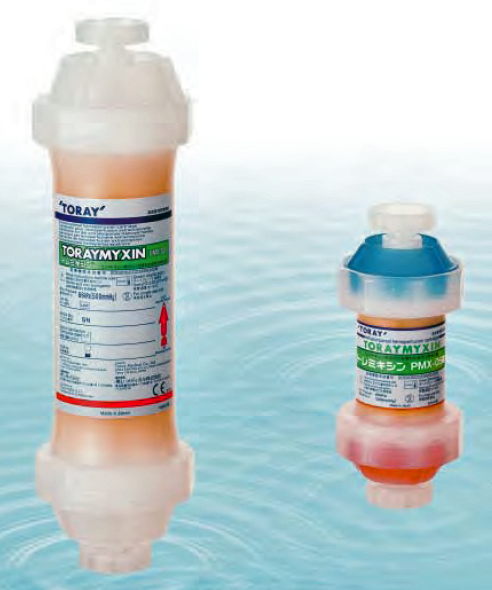
Figure. The adsorbent column containing polymyxin B in polystyrene
fiber (Toraymyxin, Toray Industries, Tokyo, Japan) used in the study. Source: トレミキシン
(TM), Toray Industries (Disclaimer: The HKSCCM has no direct commercial relationship with Toray
Industries)
Context Polymyxin B fiber column is a medical device designed to reduce blood endotoxin levels in sepsis.
Gram-negative–induced abdominal sepsis is likely associated with high circulating endotoxin. Reducing
circulating endotoxin levels with polymyxin B hemoperfusion could potentially improve patient clinical outcomes.
Objective To determine whether polymyxin B hemoperfusion added to conventional medical therapy improves clinical
outcomes (mean arterial pressure [MAP], vasopressor requirement, oxygenation, organ dysfunction) and mortality
compared with conventional therapy alone.
Design, Setting, and Patients A prospective, multicenter, randomized controlled trial (Early Use of Polymyxin B
Hemoperfusion in Abdominal Sepsis [EUPHAS]) conducted at 10 Italian tertiary care intensive care units between
December 2004 and December 2007. Sixty-four patients were enrolled with severe sepsis or septic shock who underwent
emergency surgery for intra-abdominal infection.
Intervention Patients were randomized to either conventional therapy (n=30) or conventional therapy plus 2 sessions
of polymyxin B hemoperfusion (n=34).
Main Outcome Measures Primary outcome was change in MAP and vasopressor requirement, and secondary outcomes were
PaO2/FIO2 (fraction of inspired oxygen) ratio, change in organ dysfunction measured using Sequential Organ Failure
Assessment (SOFA) scores, and 28-day mortality.
Results MAP increased (76 to 84 mm Hg; P = .001) and vasopressor requirement decreased (inotropic score, 29.9 to 6.8;
P < .001) at 72 hours in the polymyxin B group but not in the conventional therapy group (MAP, 74 to 77 mm Hg; P =
.37; inotropic score, 28.6 to 22.4; P = .14). The PaO2/FIO2 ratio increased slightly (235 to 264; P = .049) in the
polymyxin B group but not in the conventional therapy group (217 to 228; P = .79). SOFA scores improved in the
polymyxin B group but not in the conventional therapy group (change in SOFA, –3.4 vs –0.1; P < .001),
and 28-day mortality was 32% (11/34 patients) in the polymyxin B group and 53% (16/30 patients) in the conventional
therapy group (unadjusted hazard ratio [HR], 0.43; 95% confidence interval [CI], 0.20-0.94; adjusted HR, 0.36; 95% CI,
0.16-0.80).
Conclusion In this preliminary study, polymyxin B hemoperfusion added to conventional therapy significantly improved
hemodynamics and organ dysfunction and reduced 28-day mortality in a targeted population with severe sepsis and/or
septic shock from intra-abdominal gram-negative infections.
Trial Registration clinicaltrials.gov Identifier: NCT00629382
Go to JAMA here.