
Submitted by Dr Arthur CW Lau, ICU, Pamela Youde Nethersole Eastern Hospital; Date: 29 Dec 2009

Figure 1. Waterfront at North Point, Hong Kong Island, Hong Kong
A seventy-year-old lady of good past health attempted suicide by jumping into the sea at North Point (Figure 1) and had been submersed for 15 minutes. She required intubation and mechanical ventilation afterwards. She developed pneumonia and diarrhea during ICU stay. What do you think were the microbiology results of her endotracheal aspirate and stool?
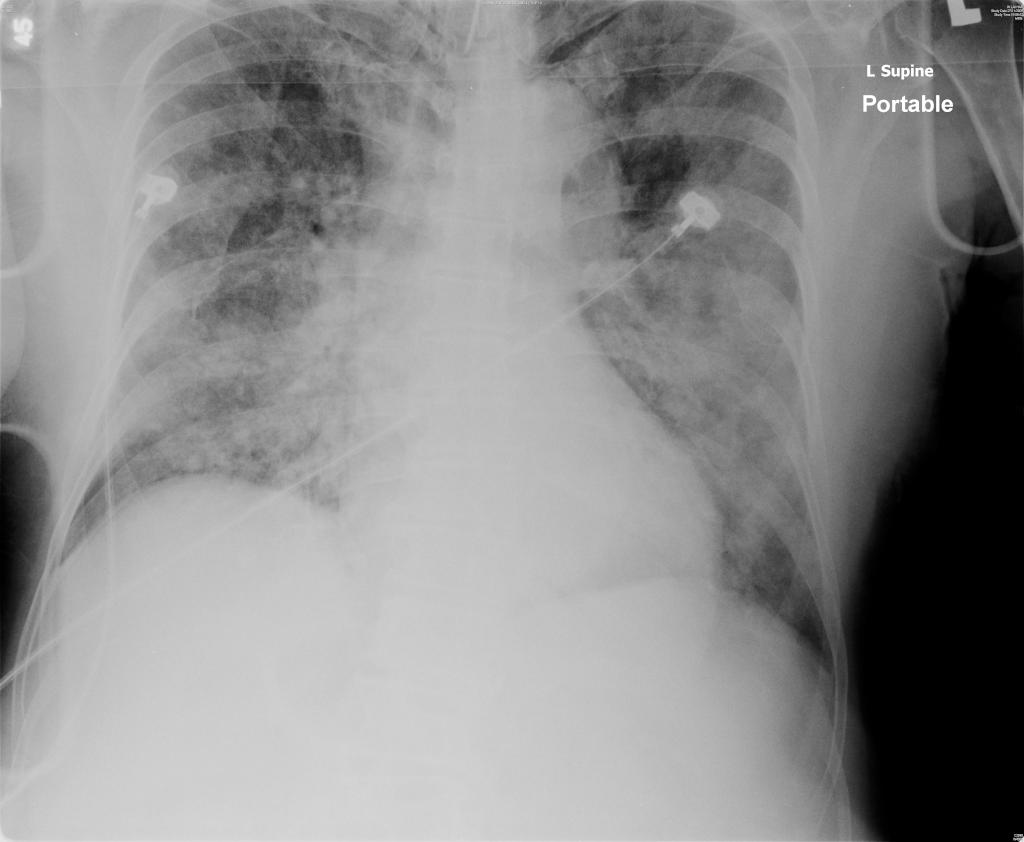
Figure 2. CXR of the patient showing diffuse alveolar consolidation
Sputum:
Initial: Proteus species (heavy), Pseudomonas species (heavy), Pseudomonas aeruginosa (heavy)
D7: E coli (ESBL +), Candida species
Stool:
Initial: Salmonella group B, RT-PCR for Norovirus positive
We could never be sure whether the above organisms were pre-existing. In a recent Italian study, from the left ventricular (LV) and right ventricular (RV) blood cultures of the 20 sea drowning victims, faecal coliforms (FC) and faecal streptococci (FS) were always isolated, whereas 19 (95%) femoral arterial (FA) and 18 (90%) femoral venous (FV) blood cultures were positive for both faecal bacteria.
Reference
Lucci A, Cirnelli A. A microbiological test for the diagnosis of death by drowning.Forensic Sci Int. 2007 May 3;168(1):34-6. Epub 2006 Jul 26. ARPA Molise (Regional Agency for Environmental Protection), Dip.Cb Via U. Petrella 1, Campobasso, Italy. campobasso.dip@arpamolise.it
Comment in: Forensic Sci Int. 2008 Aug 6;179(2-3):e79.
The present study was aimed at demonstrating the diffusion of sea water or freshwater into the bloodstream as a consequence of water aspiration due to drowning. The study was carried out on 42 study group subjects who died by drowning in salt water (20 cases) and freshwater (22 cases) and 30 control group subjects who died from causes other than drowning. For 25 cases we obtained water samples from the aquatic locations where the victims were found. The blood samples of study and control groups were analyzed to search for faecal coliforms (FC) and faecal streptococci (FS) bacteria. The presence of FC and FS was showed by the development of blue and red colonies, respectively. From left ventricular (LV) and right ventricular (RV) blood cultures of the 20 sea drowning victims we always isolated FS and FC, whereas 19 (95%) femoral arterial (FA) and 18 (90%) femoral venous (FV) blood cultures were positive for both faecal bacteria. Related to freshwater victims, LV blood cultures showed FS presence for all the 22 cases studied (100%) and FC presence for 20 cases (90.91%). Blood cultures from RV, FV, and FA showed various patterns of faecal bacteria presence. The analysis of 25 water samples from the aquatic locations where the victims were found showed the presence of FC and FS bacteria. Blood cultures from the 30 control subjects uniformly proved the absence of faecal bacteria.