
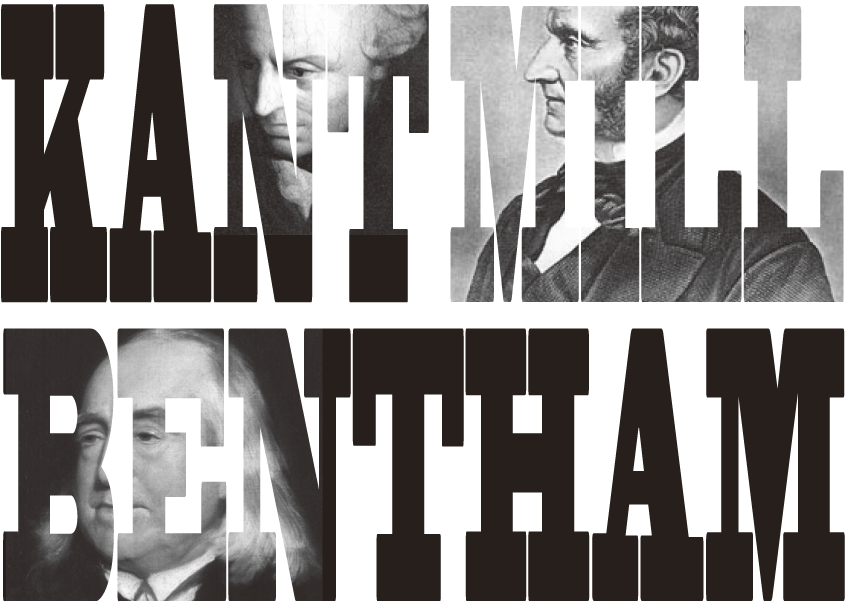
About ethics, the branch of philosophy concerned with morality and how we should act, which of the following is incorrect?
A. In consequentialism, actions are judged right or wrong by virtue of their consequences. In deontological ethics, actions are considered inherently good or evil, regardless of the consequences of the action.
B. Utilitarianism and pragmatism are examples of consequentialism. The Divine Command Theory and Categorial Imperative are examples of deontological ethics.
C. Under the condition of constraints, for example, dealing with the situation in which we can save five persons by not saving one person, the answer of consequentialists is that we must save the one instead of the five, and deontologists say we will not save the one for the five.
D. John Stuart Mill, in his book Utilitarianism, argued that Kant’s Categorical Imperative in fact used consequential logic.
Answer: C
A common contrast between deontology and consequentialist thinking is that the deontologist would argue that "the ends do not justify the means" vs "the ends justify the means". The consequentialists consider the outcome as the judgment of right or wrong, so it is right not to save the one person if this action can save five. The deontologists consider the inherent nature of the actions, so the rights of the one must be respected, and we must save the one person regardless of the fact that five persons cannot be saved as a result.
Immanuel Kant’s Categorical Imperative, an example of deontological ethics, states that we should act in such a way that we could want the motiviating principle of our action to become a universal law. John Stuart Mill argued in the opening pages of his book Utilitarianism that the Categorical Imperative that Kant had formulated to support the duties he had argued as categorical in fact used consequential logic; if the ends of a formulated maxim logically supported the maxim, that is, the maxim if universalised created a theoretical world that could exist and would be beneficial to society, then the maxim could be offered as a rule under which society should live. Mill criticised Kant for avoiding saying what the Imperative reduced to – the ends justify the means, a primary tenet of consequentialism – and thus using it to come to the opposite conclusion.
References
1.Wikepedia: Deontological ethics, Consequentialism
2. YouTube